Showing posts with label Nepal. Show all posts

Sunday, 29 March 2009

A Country of Contrasts

So what of Nepal? It's not fair for me to give an opinion on the country as a whole, seeing as I only visited three places – Pokhara, Kathmandu and the Everest Base Camp trail. But I feel I saw enough to get a decent taster of this idiosyncratic nation.

Two worlds coexist in Nepal. One world, that of the Lakeside area of Pokhara and the Thamel area of Kathmandu, exists solely to cater to Western tourists. I'm sure a lot of visitors to Nepal only see this world. It's filled with steakhouses, pizzerias, internet cafés, hotels, bars, supermarkets selling Western goods...all the luxuries of back home, at inflated tourist prices.

But step outside this charade and the real, untidy, poverty stricken Nepal can be found. With a turbulent, unstable recent history (Nepal is the world's youngest republic, having been a monarchy for a long time previous to that), the country's infrastructure is painfully underdeveloped. Even after throwing off the chains of monarchy, huge problems still exist. In a country with huge potential for hydro-electricity generation, having rolling power cuts is unjustifiable (electricity was cut for 20 hours a day when we left – though most tourist spots have their own generators). This is even more unjust when you consider that Nepal actually exports electricity to it's neighbour India.

The word on the street is that corruption at all government levels is choking the country's development, an opinion that is hard to disagree with, having seen the way the country operates. Tourism seems to be the best developed industry in the country by far, but every other aspect of the country has a long way to go.


Despite all these obstacles, the people of Nepal are, for the most part, genuine, helpful and extremely hospitable, and always with a smile on their faces. These Nepalese qualities were never more apparent than in Shiva, who we hired to bring us up to Everest Base Camp but who had no problem helping us out finding accommodation after we returned, who guided us through our first Holi festival experience and who even brought us to the airport when we were leaving the country. All this and he asked for nothing in return.

The people of Nepal deserve a better quality of life. I hope they get it some day. And I hope the people of China can match up to their Nepalese neighbours in hospitality terms.

Wednesday, 25 March 2009

Happy Holi!

After two weeks of basic accommodation and food on the Everest Base Camp trek, a week of relative luxury and relaxation in Kathmandu before tackling China was just what the doctor ordered. The highlight of this week was undoubtedly the Holi festival.


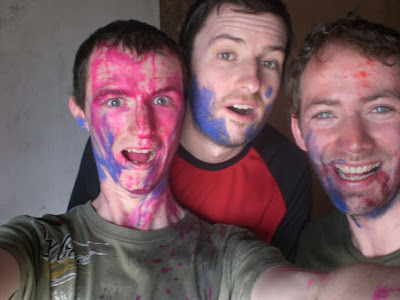
The Hindu festival of colours is an event that I could not see taking place back home in Ireland, where a whole city is turned into a coloured waterfight battleground. Throughout Kathmandu (and the rest of Nepal too we understand), shops and businesses close, and the streets become a dangerous place to stroll for those with aquaphobia and chromatophobia (a fear of colours – and yes I did have to look it up).

We were lucky in that we had pre-warning of these events thanks to our Everest Base Camp guide, Shiva, who very kindly had no problems guiding us through the festival as well. Dressed in our worst, Shiva took us from our hostel to the trekking office, where unlike most Westerners we were able to become hunters rather than targets by basing ourselves on the balcony of the office, overlooking innocent passers-by below.


A healthy supply of water balloons and food dye made many of these (in particular female) passers-by suffer. It was all part of the festival fun, well for us anyway!


Shiva had also very generously offered to cook us dinner at his home, which was a twenty minute walk away from Thamel. Leaving the twin comforts of a strategic balcony position and Westerner-friendly Thamel, the hunters most definitely became the hunted. Walking through what seemed like an endless stretch of residential areas, where we were the only Westerners, we became the preferred bounty of every rooftop and street-based festival participant, getting pelted from every angle with coloured water. Toward the end of this journey we started to wallow in self-pity, with gangs of schoolkids (who had the day off – for a waterfight!) picking on us, and the locals on the rooftops taking great pleasure to bombard the Westerners who were foolish enough to stray this far from the safety of Thamel.

Our dignity barely surviving, we made it to Shiva's house. Shiva lives in a single room, with a toilet that's shared between the whole neighbourhood. Thinking that Shiva made good money from his work, it was humbling to see where this man lived, in comparison to the complete luxury (relatively speaking) we inhabit. Everyone in his neighbourhood were in similar dwellings, and the sense of community, the kind of which is fast disappearing in Ireland, was in every sense apparent.

Our basic but filling meal was eaten graciously, after which we had a few beers in the communal yard outside Shiva's room, along with Shiva, Gopal (our porter on the base camp trek), and most of the neighbourhood.


Thamel isn't the real Nepal, this was.

Friday, 20 March 2009

What Goes Up... (39)


A hike down an impossibly wide valley brought us to Pheriche (4243m), where we enjoyed the increasing levels of oxygen in the air. The next day, we descended further to Phortse (3750m), a hike on which I suffered from belated altitude sickness with a dodgy stomach (although my stomach may have been rejecting the food it had received for the past week).


This alternative return path provided us with some of the best scenery of the whole trek. From Pheriche, we continued on to Phortse (3750m), and after a night here made our way back to Namche Bazar, overcoming a descent down some very steep steps along the way.


On the way to Namche we stopped off at the amazing Khumjung (3790m), one of the biggest towns we visited on the trail, which also had it's own Buddhist monastery (which allegedly has a Yeti skull), as well as the Edmund Hillary school.

Once we reached Namche, we knew we were at a low enough altitude to celebrate a little, and celebrate a little we did, with beers and cigars.


This, unsurprisingly, was one of the most enjoyable moments of the thirteen days.

Day twelve, and our routine hike back to Phakding was made more interesting by the fact that Friday evening and Saturday morning are market day in Namche, meaning that the trail was jam packed with market goers, and many yaks, heading in the opposite direction to us.


Yak Attack 2
This state of affairs led to our second yak attack. This time I was at the rear. Coming over the brow of a hill, I could hear some commotion up ahead. Then John, who was in front of me, informatively shouted “Oh shit!”, and dived into the ditch next to us. Looking up, I was faced with a yak charging straight towards me. I just about managed to dodge it, otherwise I don't think I'd be capable of writing this blog entry.

After a boring night in Phakding we arrived back in Lukla the day before our early morning flight to Kathmandu. With no flights in or out of Lukla that day due to inclement weather, there was a healthy population of trekkers eager to celebrate, not least of all us.


“The Irish Pub”

Believe it or not, Lukla has an Irish bar, with the imaginative title “The Irish Pub”. As is usual around these parts however, it's an Irish pub only in name, more resembling the basement of a rich American with Irish roots. The celebrations continued on for the rest of the night, culminating in traditional (or maybe not) Nepalese dancing from all involved. Only John was caught on video though.

The airport departure room (calling it a lounge would be a stretch) the next morning was like a big reunion of all the fellow trekkers we had met in the past fourteen days. I reckoned this is what a school reunion must feel like.


Our collective attention was drawn by some commotion on the runway before the first plane of the morning had landed – a local child had somehow escaped it's house and made it's way on to the landing strip! Cue army officers rushing to remove the toddler from danger – a sight I don't think I'll see at any other airport. A downhill takeoff was also a sight to behold (and cause fear).

So the highpoint, literally, of our whole trip ended up a complete success, and is something that I'd recommend to anyone. If you're prepared to rough it a little for a couple of weeks, the rewards make it all worthwhile. An incredible expereince.

Kala Patthar Peak (5550m, 18,208ft)


Because It's There

So what's involved? Fourteen days hiking, eight and a half of which were spent climbing and the rest getting back down, that was what faced us. The itinerary was outlined to us a couple of days before we set off, when we also briefly met our guide, Shiva. On paper, it looked difficult. Not being the most naturally athletic person in the world, at times I was more anxious than excited. But I was anxious about this whole trip too, doing things that scare me is a recurring theme in my life at the moment, and there was no way that I was pulling out now.

Day 1 to 3
Our early morning taxi ride to the airport was beset with problems. First, our porter, the superhuman Gopal, who would be carrying most of our gear the whole way up and back, had trouble getting out of bed, and was late getting to his pick-up point (this was the only blemish on his flawless performance during the rest of the trip). Then it turned out that this particular day there was a big festival on (marijuana was legal in Nepal for one day!), so a main bridge on the route to the airport was closed, causing traffic chaos. We ended up missing our 7am flight to Lukla (2886m), but no harm done, we just caught the 8am.

The view out of the cabin windows gave us a nice taster of what was to come, and the landing, despite the hilarious runway at Lukla, was fine. The first thing that I noticed about the area was the lack of roads or automated land vehicles of any sort. To get anywhere around here there was only one way of doing it: walk. So that's what we did, for just over two hours, to our guesthouse for the first night at Phakding (2640m). Accommodation was basic, which we expected, and very cold, which we didn't expect, not at this relatively low altitude anyway. Having been spoiled by the constant sunshine we'd had so far, the bitterly cold nights took some getting used to, as did arriving somewhere at lunchtime and having nothing to do but rest for the remainder of the day.


Day two's longer four hour hike (including a stop for an early lunch) was easy even by my standards, and made enjoyable by the surroundings, which were very similar to the British Columbia nature trails, all rocky valleys and lush forest. We also caught our first tantalising glimpse of Everest, which of course wouldn't be our last.


Namche

A one hour climb, which wasn't difficult at all due to the very easy pace set by our guide Shiva, directly preceded our arrival at a windy and cold but scenic Namche Bazar (3440m), where we spent the next two nights acclimatising. So far so easy!

Day 4
The quality of the scenery on our path really stepped up a gear on our fourth day, the green forests slowly transforming into more barren yet more spectacular views of snowy peaks. As a rule on the trek the more spectacular the scenery got the more the temperature dropped, so more and more layers were needed.


After passing through a few Sherpa villages and past plenty of yaks, and another steep (but not too taxing) climb we arrived in Tengboche (3867m), a village quite exposed to the elements and hence quite windy. Inside Tengboche Buddhist monastery however, the largest in the region, the turbulent weather conditions outside are comprehensively concealed, with opulence and spirituality oozing out of every corner of the place, a peaceful oasis on a stormy hilltop. It was amazing to see a place of worship like this.

Yak Attack
Our fifth day is remembered for one event in particular. We were trekking uphill through a typically small Sherpa village, when a herder just up ahead lost control of his Yaks. They started charging straight at us. Shiva, our guide, sprinted across the street and leapt up onto a wall. I instinctively followed him, as I had been walking just behind him. With no time to do the same, Gearóid and John had to balance on a narrow wall on the other side of the street, with a four metre drop into a yard on the other side of the wall. A belt from a yak and they wouldn't have been able to continue, that was certain. The yaks managed to maintain their direction though, and charged past us at serious speed.


These animals, though not intentionally violent towards humans, could really cause some damage if collided with. In fact Shiva told us there had been four deaths and plenty of injuries caused by yaks in the last ten years or so.

After that bit of excitement we arrived in gusty Dingboche (4260m). With the oxygen levels in the air depleting, altitude sickness started to kick in. John was the first to suffer, losing his appetite completely (a serious symptom for a man that normally eats inhuman amounts of food). We all experienced mild headaches too, but for now Gearóid and myself were not too bad.


We also spent the sixth day in Dingboche as planned to once again get our bodies used to the altitude we were inhabiting, during which we stopped at the spectacular view above.


Dingboche was also very cold, with sub zero temperatures at night meaning we spent our time huddled around the fire until it petered out, at which point everybody hurried back to their room and into their sleeping bags. John was very sick at this stage, showing more of the symptoms of altitude sickness, which are quite similar to a bad hangover (some justice at last I thought, as he normally doesn't get hangovers). Only two days until base camp, we told ourselves.

Day 7


For me the seventh day started with some hearty Tibetan bread with jam, providing fuel for the tough day that was to follow. With the air getting thinner, and our breaths becoming ever more shallow, every uphill section became more and more difficult. The land at this altitude is extremely barren, unwelcoming to life requiring oxygen.

Arriving exhausted at Lobuche (4930m), I collapsed onto the seating bench and immediately realised I was very sick. No appetite, bad headache, unsettled stomach – it wasn't nice at all. Also not the time to meet three very friendly and chatty German trekkers, who happened to be from Stuttgart, where John and I had lived for six months a few years ago. One of them even lived about a five minute walk from where me and John resided. Luckily John had recovered somewhat from his illness, and was able to lead the conversations, while I was slumped into my seat behind him.

Base Camp Day
Thankfully I had recovered enough to continue on the morning of day eight, as this was the day we were to make it to base camp. With the landscape, temperature, oxygen levels and uphill sections ever more forboding, the incentive of the achievement that awaited us was badly needed to keep motivation levels up. A tough four hour initial hike brought us to Gorak Shep (5180m), where we were to spend the night. But after a quick stop there to deposit gear and order some some barely touched food, we wearily set off for base camp.

By now the spectacular had become the norm, or perhaps we were too tired to appreciate the scenery, but whatever, this hike was tough for all of us. Very rocky, with many ups and downs (both personally and terrain wise), every little ascent felt like a little Everest. But finally, after a climb past rocky paths with ice up the side of the Khumbu glacier, we saw the marker.


The sense of elation and relief from all of us was palpable.

It's Not Over Yet
After struggling back to Gorak Shep, we rested, still glowing with the sense of achievement. My body had successfully adapted to being above 5000m, but John and now Gearóid's condition took a real turn for the worse. Tomorrow we began our descent, but first there was the extra challenge of Kala Patthar, a Himilayan peak of 5550m (18,208ft). It was looking like I was the only one who would be able to tackle it, which I didn't want.

The next morning I dragged myself out of bed and reported for trekking duty. The only other trekker up was Ann from Oxford, whom we had met on day three, and also happened to meet at base camp itself. At least I had someone to share the experience with, I thought. But then, like Lazarus, John appeared, declaring himself healthy enough to go for it. So off we went.

In the whole thirteen day trek, this one hour forty five minute climb was the toughest part by a distance. It started out tough, then got progressively steeper. Towards the end Shiva stated that we were almost there, only for us to turn a corner and be faced with an even steeper section made up of small boulders. Almost at the peak, it got to a stage where it was three steps, break, three steps, break, for both John and I. There was simply no oxygen to keep us going. But at the top...

Monday, 9 March 2009

Gearing Up

We booked our Everest Base Camp trek early in our second day in Kathmandu, with a trekking crowd we found ourselves. Though they weren't the cheapest, they seemed the most professional, and you want confidence with the company who are responsible for your wellbeing on an undertaking like this.

Having packed for the hot Indian climate, I was hopelessly under-equipped for a hike up to 5400m, as were John and Gearóid. So the two days before departure were spent gearing up.

Even more common than trekking companies and bars and restaurants in Thamel are shops selling trekking gear. Almost everything sold here is a cheap knock off of well known trekking brands such as The North Face. Seeing as I'd only really be using the gear for the 14 day base camp trek, I was only concerned with it lasting that long.

After a lot of haggling in numerous shops I ended up buying a warm hat, a sunhat, gloves, a long sleeved top, hiking sticks, a small backpack, a water bottle and lots of chocolate. All that for roughly €20. With the cost of the trek itself blasting our Nepal budget out of the water, I needed to go cheap. I just hope cheap lasts the 14 days.

Trekking for Treks

Our first priority in Kathmandu was to get the Everest Base Camp trek organised. It's not hard finding someone to book a trek with in Kathmandu. Every third building seems to house some trekking company or other. Finding a trekking organisation we wanted to go with was the hard part.

Unsurprisingly our hostel host knew someone who organised treks – his sister as it turned out. She was the first person we talked to. Her package sounded good and the price was around what we expected. However we weren't going to jump into bed with the first offer (unless that was what she actually wanted). We decided to follow a tout to another trekking company this time, and it was a lot cheaper with this crowd.

I had spotted a Céad Míle Fáilte sign while we were looking for accommodation, so we ventured to the Irish pub next in the hope that someone Irish there could be a valuable source of trekking information. Just before we reached it, another trekking tout approached us. We explained to him that we were going upstairs to the pub first, and that we'd talk to him afterwards. So up we went, to be greeted by a horrible imitation with a Nepalese barman and no-one else inside. To our disbelief, the tout followed us up and sat at the table next to ours. We hadn't come here to be hassled by a bloody tout. So we left.


Thirsty for a drink after that annoyance, around the corner was a Lonely Planet recommended watering hole named Tom & Jerry's. One drink led to more, and the end to any trek searching for that day. We ended up having a great night, properly on the lash for the first time since we had left home.

Backpacker Central

As the capital of Nepal, and the base for our planned trek to Everest Base Camp, Kathmandu was the obvious choice for our second stop in Nepal. After the nightmare that was our bus journey to Pokhara, we paid a bit more for a proper tourist bus this time round.


Some of the scenery on the journey was stunning. Nepal really is a country brimming with scenic beauty, and thrillingly most of the road had nothing but a huge drop at it's edge, making the five hour journey seem like five minutes.


Motoring through the outskirts, Kathmandu seemed similar to the big Indian cities, except far more hilly, and a bit cleaner. There was definitely a lot more advertising present, and our route to the bus stand was lined with numerous motorbike garages, most of which had Duckhams or Castrol livery. The air was also similar to Indian cities, with a pollutant haze clearly present, a far cry from Pokhara's clear horizons.

Departing the bus, the same routine as Pokhara was used: get a taxi straight to the backpacker area, lie to the driver that we have a hostel booked, and then once there search for the cheapest place on foot. Thewal really is a haven for backpackers. Western food is available everywhere, and the narrow streets are lined with bars, including an awful Irish pub.


Standing out with our backpacks still on us, we became a target for touts offering accommodation. Funnily enough this worked to our advantage, because it was though a tout that we found a cheap place in a fine location. Your wallet stays healthier if you don't mind dingy accommodation.

Once the backpacks were off though, we were still a target for touts, along with the huge number of other Westerners there. Thewal is trekking central, with far more trekking companies than willing trekkers, so the trekking touts were the worst, in your face every thirty seconds pushing this trek and that. Luckily my time spent in India meant I knew exactly how to handle them: pretend they aren't there.

The Sincerest Form of Flattery

I'd previously mentioned that Lakeside in Pokhara is very Westernised. Western food is promised all along the strip. There are even a couple of Italian restaurants, and a few steakhouses. A lot of effort has been put in to making Westerners feel more comfortable. Some of the food is really good, tasting as good as you'll get back home. One night I had a proper thin crust Italian pizza, which was made by Nepalese hands but was the best pizza I had eaten in a good while. There are hundreds of Nepalese employed here in the art of imitating Western cuisine.

And it's not just food, music is replicated too. On a walk down the main street our first night we heard bloody U2 being blared out from Club Amsterdam café by an all Nepalese cover band. There are a handful of coverbands here, who rotate between a few different venues, playing Pink Floyd, Leonard Cohen, Jimi Hendirx, U2 and plenty other covers. And as cover bands go, they're not bad. Seeing a pony tailed Nepalese rocker pull off a Hendrix guitar solo is definitely one sight I didn't expect in Nepal. Maybe they should put that image on the Lonely Planet cover.


On probably our best night in Pokhara we even discovered a Jazz bar. We had a fun few drinks with a Canadian and two Israeli girls we met inside who were volunteering at a local orphanage. They were the only other people inside the place. But despite this lack of an audience, and to my complete surprise, four Nepalese guys took to the stage and started banging out some decent sounding jazz.


The drummer in particular was exceptional. Encourage by our enthusiastic applause, they played on past last call, and had to be asked to stop playing, at which stage we were thrown out. At this stage I'd forgotten where I was (and it wasn't just because of the beers).

It Had to Happen Some Time

I was delighted to get through India without once suffering the dreaded Delhi belly. I was under the impression that once I got past there then the food would be cleaner and safer. I'm not sure where I got this impression from, because it was completely wrong. Nepal is even worse than India for food hygiene.

I'm sorry to say I have first hand experience. My time in Pokhara was ruined by illness. This really grated me, because when you have such a fantastic place outside your room door, it's incredibly frustrating to be stuck behind it. I spent a lot of time pointlessly pondering what had caused my uncomfortable state, but it really could have been anything. Poor Gearóid had a bad case of it too.

I hadn't felt well ever since the bus journey to Pokhara. The first night I just felt under the weather, the second day I felt the same. I even felt a little better after a relaxing kayaking session out on the lake. But the third day it was full on keep close to the bathroom sickness. By that stage I was sick of being sick. I had picked up some Indian strength prescription only pills over the counter (!) in Delhi (I had heard that Ireland doesn't have anything strong enough). They worked. Be careful what you eat in Nepal.

Is food hygiene as dodgy in China?.

Rice Break

Arriving in Pokhara a few kilometres outside Lakeside, the backpacker hub, on the advice of Lonely Planet we lied to our taxi driver and told him we had a place booked already. This worked, he took us straight to where we wanted to go, and left without a fuss and without trying to bring us to somewhere where he'd make commission.

The area around the bus stop was in old Pokhara, which looked quite similar to a lot of other Nepalese towns we'd passed through. Lakeside however was very Westernised, the long main street lined with eateries offering steak and pizza, with numerous small roads off the main street containing a cluster of hostels. It was also amazingly quiet and clean. After three weeks of India, seeing a street almost clear of people and rubbish was a refreshing sight.

Lakeside gets it's name, amazingly enough, from being located along the southern bank of Phera Lake, giving the place an idyllic atmosphere. Pokhara was once a big stop on the hippie trail, and I could see why. The place still had a chilled out vibe, left over since those hedonistic days. I liked it immediately.


I know I mentioned how much I loved the food in India in a previous post (John and Gearóid loved it too), but I really really needed a break from bloody rice. And Pokhara was the place for it. After finding ourselves a place to stay, our empty stomachs were filled with pizza (me) and steak (the other two). The pizza wasn't great, but with not a rice grain in sight, I was satisfied (as were the other two). One Western splurge is acceptable, we told ourselves.

Best Seat in the House

According to the Lonely Planet Guide to Nepal:

“Bus travel in Nepal poses a significant risk of accident. It's uncommon to drive for more than an hour on any stretch of road without passing the burnt-out shell of a public bus crushed like tin foil into the canyon below. Travelling on an overnight bus trip is probably the most dangerous thing you can do in Nepal, and is certainly a bigger risk than that currently posed by the Maoists and even more dangerous than the bungee jump (only kidding on that one). You are more than 30 times more likely to die in a road accident in Nepal than in most developed countries.
During the course of researching this guide we passed ten fatal bus crashes in one ten-day period, which between them killed over 200 people. Tourist buses are generally safer than public buses but still the message is clear; keep bus travel to a minimum.”

They sounded great! With no trains in Nepal, the only alternative was to fly into Kathmandu, but that would mean gaining 1000m in altitude in a couple of hours, and besides that we wanted to go to Pokhara first. So we took our chances with the buses of death.

Having been promised a tourist bus by the agent in our hotel we booked with, we boarded the bus early the next morning to be greeted by nothing but Nepalese on board. We were directed to the tourist section, which basically meant sitting in the driver's cab area, which was separated from the passengers in the back with a plywood wall and a small door. I got to sit right up front, so I had an unobstructed view of the roads ahead.

The journey had barely begun when a traffic policeman halted it. The main road was closed. After much shouting and gesticulating, the bus driver reluctantly tried to find a detour. Down one unpaved street, we came screeching to a halt. There was a chasm in the road, which was hard to spot in the pre-dawn darkness. The driver's helper got out and inspected it. Too wide. No shit, it was about a metre gap! The batteries in my camera were dead so I was unable to get any photos unfortunately.

A detour from the detour meant we ended up driving through what seemed like one huge quarry for about 10km. I've never gone quadbiking, but I'd imagine a course is similar to what we drove through.

Like the local buses in India, we stopped to pick up and drop off passengers all along the way. The closer we got to Pokhara the busier the bus got. For the last four hours of the journey I was sitting at the windshield, along with a Nepalese lady, her son (neither of whom spoke a word of English), the gearstick (who didn't speak at all) and the driver (who shouted a lot), all cosily squeezed together. This was the best seat in the house to witness the no holding back overtaking around blind corners with a 500 foot unbarriered drop beside the road lunacy of our heroic driver. We got there in the end.

Next Country Please

India to Nepal was my first overland (non-EU) border crossing, and I wasn't sure what to expect. As it turned out, Nepal proved easier to get into than the Bróg on a Saturday night.


With no bag or security check to speak of, we actually entered the country with no visa, and had to ask at the tourist office for the location of the visa office. Backtracking to the visa office, we paid our US$40 and had our passports stamped within 15 minutes. American border patrol it ain't.

Our first task in our new country was to swap our Indian rupees for Nepalese. We were delighted to learn that one Nepalese rupee is equivalent to one (Euro) cent, making converting prices to Euro a sinch. 100 Nepalese rupees equals €1. We weren't as pleased with the actual Nepalese notes. It's very difficult to differentiate between any note smaller than 1000 rupees, with many notes of the same value having their own variations. To make matters worse, the Nepalese government has introduced new plastic notes with references to the royal family removed, due to the removal of the monarchy from power in Nepal a couple of years ago.

Compared to India, the country seemed more geared for tourism from the start. Having a very helpful tourist office close by when we entered the country was the first sign of this (tourist offices were thin on the ground in India). While we were queuing for our currency exchange, a begging child was chased away by an employee with a pair of pliers! I'm not condoning this treatment of the child, just pointing out that it would never happen in India.

Making our way to a town called Bhairawa 4km from the border where we were to stay overnight, another main thing we noticed was: bars! Alcohol adverts were strewn across many buildings, which, coming from a country where we were often asked to hide our beer bottles under the table, was a comforting sight.


We no longer had to feel guilty about asking for a beer, and it showed.